Types of Forex Markets
Spot Forex Market
The spot market involves the exchange of currencies at the current market price, known as “on the spot.” Trades are settled immediately or within a short period. Many online Forex trades are based on spot market prices, even when traded through derivatives.
Forward Forex Market
The forward market involves an agreement to buy or sell a specific amount of currency at a fixed price on a future date. These contracts are commonly used to plan ahead and manage currency risk.
Futures Forex Market
The futures market uses standardized contracts traded on exchanges. These contracts lock in a price and date for buying or selling a currency in the future.
FOREX PRICING - BASE AND QUOTE CURRENCY
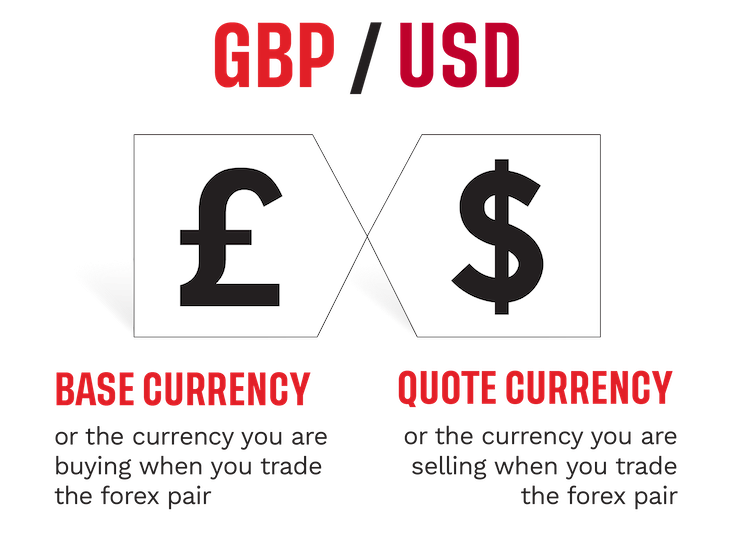
The first currency listed in a forex pair is called the base currency, and the second currency is called the quote currency. The price of a forex pair is how much one unit of the base currency is worth in the quote currency.
In example, GBP is the base currency and USD is the quote currency. If GBP/USD is trading at 1.35361, then one pound is worth 1.35361 dollars.
If the pound rises against the dollar, then a single pound will be worth more dollars and the pair’s price will increase. If it drops, the pair’s price will decrease. So, if you think that the base currency in a pair is likely to strengthen against the quote currency, you can buy the pair (going long). If you think it will weaken, you can sell the pair (going short).
What Is Leverage in Forex Trading?
Leverage allows you to trade a larger position in the Forex market using a smaller amount of money.
Instead of paying the full value of a trade, you only need to deposit a small amount, called margin.
However, your profit or loss is calculated on the full size of the trade, not just the money you deposited.
Leverage can increase potential gains, but it also increases risk, which is why it must be used carefully.
What Is Margin in Forex Trading?
Margin is the initial deposit required to open and keep a leveraged trade open.
It is usually shown as a percentage of the total trade value.
For example, if the margin requirement is 2%, you only need to deposit 2% of the trade’s total value.
So, for a trade worth $10,000, a 2% margin means you would need to deposit $200.
Even though the deposit is smaller, you are still exposed to the full $10,000 movement.
What Is a Pip in Forex Trading?
A pip is the standard unit used to measure price movement in Forex.
For most currency pairs, one pip is a change in the fourth decimal place.
For example, if GBP/USD moves from 1.21484 to 1.21494, it has moved one pip.
Some currency pairs, such as those involving the Japanese Yen, use the second decimal place instead.
For example, if EUR/JPY moves from 172.119 to 172.129, it has moved one pip.
The smaller decimal values after a pip are called pipettes and represent fractions of a pip.
What Is the Spread in Forex Trading?
The spread is the difference between the buy price and the sell price of a currency pair.
When you buy a currency pair, you enter the trade at the buy price.
When you sell, you enter at the sell price.
The spread is effectively the cost of entering a trade and is measured in pips.
What Is a Lot in Forex Trading?
Forex trades are made in standard sizes called lots.
Standard lot: 100,000 units of currency
Mini lot: 10,000 units
Micro lot: 1,000 units
Most individual traders do not trade the full value of a standard lot.
Leverage allows traders to control larger positions using a smaller margin deposit.